Reviewed August 2026 · pending states, address errors and recovery
ETH online casino cashier failures nobody can reverse
In brief
A transfer that fails is not the dangerous outcome on an ETH online cashier. A transfer that succeeds is. The address was well formed, the network accepted it, the explorer shows a completed transaction, and the casino balance has not moved, because the money arrived somewhere nobody is watching. This site is about that class of mistake: what the pending state is actually waiting for, which address errors the built-in checksum catches and which slip straight past it, and where the line falls between a loss a support ticket might unwind and one that is final by construction.
The five operators here behave differently once something has gone wrong. Casinova (9.4) and Betwest (9.3) publish an operator window of 0 to 24 hours, Kingmaker (9.2) and Cleobetra (9.0) 0 to 48, Betrepublic (9.1) 24 to 72, and every one of those is the operator's own queue rather than the chain. Cleobetra prints the network beside the deposit address. Betwest verifies identity before the first withdrawal, so it cannot be used to hold a payout. Kingmaker carries the smallest bonus of the five, so the cashier clears sooner. None of them is licensed in Australia: the Interactive Gambling Act 2001 prohibits offering these games to Australian residents and ACMA blocks sites that do, so an Anjouan or Curaçao licence buys nothing locally, and nothing you send is reversible. 18+ only.
Rosa Lindqvist · ETH cashier mechanics and failure modes · reviewed August 2026
The five ETH online cashiers, read for what happens when a deposit goes wrong
✓Network confirmed beside the deposit address✓How a pending deposit behaves✓Payout destination rules✓When identity is established
The casino operators behind these ETH cashiers
Kingmaker Casino
9.2/10
Bonus: 50 Free Spins + A$800
Kingmaker Casino’s welcome package of one-hundred percent up to five-hundred euros plus fifty free spins demands thirty-five times wagering on the cash amount and forty times on the spins. Maximum single bet while the bonus is active sits at five euros, and no advertised ceiling applies to eventual cash-outs.
Canadian players receive the bonus after a twenty-euro minimum deposit and can track the requirement in real time on mobile or desktop. The Curaçao licence keeps the brand outside any provincial iGaming framework, offering unrestricted access to the full catalogue of thirteen-thousand-seven-hundred games without local regulatory hold-backs.
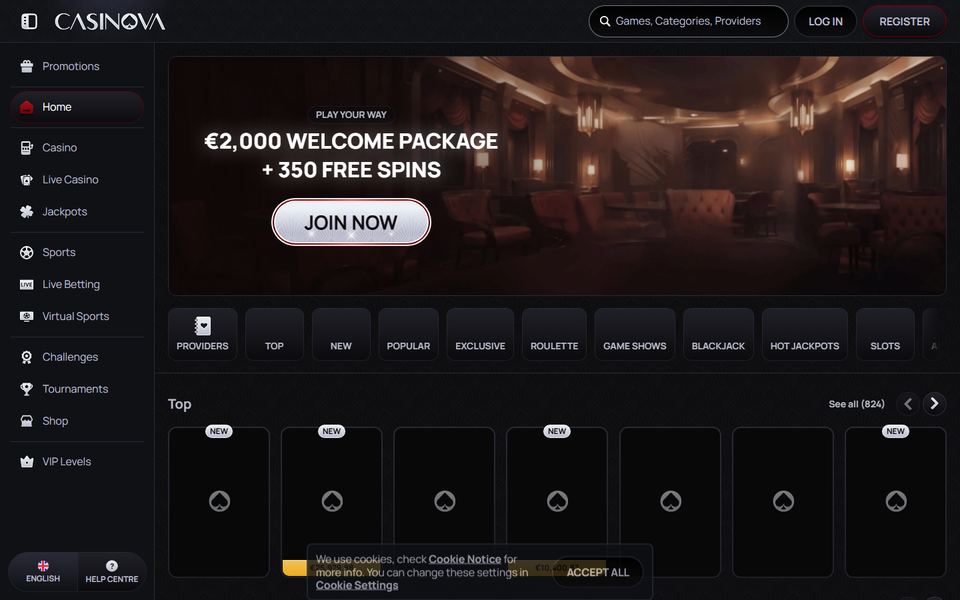
Casinova Casino’s lobby showcases roughly thirteen-thousand-eight-hundred titles, including one-hundred-twenty-seven providers and a Gold Saloon live section that streams blackjack, roulette and baccarat in HD. Progressive jackpots sit next to Megaways and classic three-reel games, giving Canadian players plenty of variety on any screen size.
The welcome package delivers up to two-thousand euros plus three-hundred-fifty free spins, each stage unlocked with a twenty-euro deposit. Forty-times wagering, a one-hundred-euro max bet and a ten-times cash-out cap frame the offer, while twelve-hour payout windows keep the experience smooth across desktop and mobile.
Cleobetra Casino operates under an Anjouan licence issued to NovaForge Ltd, a regulator that permits Canadian players to join without provincial licensing hurdles. The offshore status simply means the site follows Anjouan rules rather than any Canadian provincial framework, resulting in fewer geo-blocks and faster feature roll-outs.
Welcome package offers one-thousand euros plus three-hundred-fifty free spins with thirty-five times cash wagering and forty times on spins. Maximum bet during the bonus is five euros and winnings are capped at ten times the bonus amount, all settled within eight-hour payout windows once KYC is complete.
BetRepublic accepts CAD deposits via Interac, credit cards and several e-wallets that clear instantly on both desktop and mobile browsers. The responsive lobby adapts to any screen size, letting Canadian players move from the sports header to live dealer tables without downloads.
Casino welcome reaches two-thousand euros plus two-hundred free spins across four deposits, and the sports bonus matches one-hundred percent up to two-hundred-fifty euros. Wagering requirements are thirty-five times on cash and forty times on spins, with a one-hundred-euro max bet and ten-times cash-out limit, all handled through the same mobile-friendly cashier.
BetWest processes withdrawals to Canadian bank accounts or e-wallets within twenty-four hours once KYC documents are approved, typically within one business day. The offshore licence held by Westbound Ventures Ltd means the site does not display a formal regulatory seal, but payout speed remains unaffected.
Welcome package tops the set at five-thousand euros plus three-hundred-fifty free spins, each stage requiring a twenty-euro deposit. Thirty-five times cash wagering, forty times on spins and a one-hundred-euro max bet apply, together with a ten-times cash-out ceiling, giving Canadians a fast, high-limit route from deposit to withdrawal.
Where each cashier protects you, and where it leaves you exposed
Kingmaker Casino
License Curaçao · 9.2/10
Pros
Crypto deposits and payouts supported
Operator handling 0–48h, chain settles in minutes
Smallest bonus, so the cashier clears sooner
Cons
Not licensed in Australia (Anjouan)
Limit increases with little cooling-off
Casinova Casino
License Curaçao · 9.4/10
Pros
Shortest operator handling here: 0–24h
Short queue, so short price exposure
Crypto alongside cards and e-wallets
Cons
Not licensed in Australia (Curaçao)
No dedicated app for the cashier
Cleobetra Casino
License Anjouan · 9.0/10
Pros
Network named on the crypto deposit screen
Operator handling 0–48h, then minutes on-chain
Best-built interface of the five
Cons
Not licensed in Australia (Anjouan)
Smallest game library of the five
Betrepublic Casino
License Anjouan · 9.1/10
Pros
One crypto deposit funds sportsbook and casino
One network fee, one payout queue
Limit applies to the shared balance
Cons
Not licensed in Australia (Anjouan)
Longest operator handling: 24–72h, price exposure runs with it
Betwest Casino
License Offshore · 9.3/10
Pros
KYC up front, cannot be used to hold a payout
Operator handling 0–24h, then minutes on-chain
Largest library: 3,000+ titles
Cons
Not licensed in Australia (offshore)
Very large bonus stays live and can block a cashout
Eth Online Casino: a confirmed transfer that never reached the account
A transfer can clear on the blockchain and still fail to reach your casino balance, which is exactly the situation this section traces. You copy it. You switch across, paste it into the destination field, type an amount, approve. The wallet raises nothing: no red banner, no warning strip, no second dialogue asking whether you are certain. Half a minute later the transaction has a hash and a tick beside it. The casino balance still reads zero.
You refresh. Zero. You wait five minutes, refresh again, still zero, so you open a block explorer and paste in the hash. Everything there is green. The transaction was included, it succeeded, the full amount left your address and arrived at the address you pasted. Nothing in the record suggests a problem, and that is precisely the problem. There is no failure anywhere in the sequence to point at.
Here is what happened. The address was correct. The amount was correct. The network was not. The 0x form is shared across a family of compatible chains, which means the same forty-two characters describe a perfectly valid destination on every one of them. The operator generated that string on the chain named on its deposit screen, and that is the only chain where anything is watching it. Your wallet was pointed somewhere else, because the last thing you did in that wallet was somewhere else, and it stayed there.
Nothing in the sending flow objected, because from the wallet's point of view nothing was wrong. It was asked to move a balance to a well-formed destination and it did. The explorer agrees. The receiving side is the only party that could have raised an objection, and the receiving side was never involved, because on that chain the address is not a cashier. It is just an address.
What follows is a support ticket. You write in with the hash, the amount and the account the deposit was meant for, and the reply, if it is honest, describes a manual process rather than a fix. Whether the funds can be moved at all depends on how the operator holds keys, on whether the same key material is usable on the chain you sent to, and on whether anyone there is willing to do the work by hand. Some operators will attempt it. Some decline outright. None of them owes you a result, and nobody should be telling you the money is coming back.
That single evening contains most of what this site is about. Not one step in it was careless in the ordinary sense. The player read the address, read the amount, waited for the acknowledgement. The mistake sat in a field nobody looks at twice, and every piece of machinery downstream had good reason not to complain about it. The rest of this page is variations on the same shape: a step that worked, in a place the cashier was not looking.
Reading the pending state on a cashier
A casino deposit sits in pending long enough to feel identical to a failed transfer: the cashier acknowledges you within seconds, then two different waits hide behind that one word, and you cannot tell which.
A correctly submitted deposit sits in pending state on the cashier long enough to feel identical to a failed transfer. The cashier acknowledges you within seconds and then says pending, and it goes on saying it for long enough that you start to wonder whether Tuesday is repeating itself.
Two entirely different situations hide behind that one word, and the cashier rarely tells you which one you are in.
In the first, the network has not yet settled the transfer to the operator's satisfaction. Your transaction has been broadcast and picked up, but the operator has not decided it is durable enough to build a balance on. That threshold is a judgement, not a physical constant. Nothing in the protocol declares a transfer final at a particular instant; what exists is a gradient of how difficult it would become to unwind, and every operator draws its own line across that gradient wherever its risk appetite puts it.
In the second, the transfer settled some time ago and the operator's own rules are holding the credit. Risk screening. A first-deposit check. A mismatch between the sending address and anything the account has used before. Or simply a queue with nobody working it at three in the morning in a timezone that is not yours.
So the honest description of pending at a casino cashier is that it is a policy expressed as a status. The chain has no such state to report. Ask what the cashier is waiting for and, most of the time, the answer is itself.
Two practical consequences follow. The first is that crediting behaviour can differ by asset on the same cashier, because the native coin and a token issued on the same chain are read by different parts of the operator's system, and one can be released while the other waits. The second is that it can differ by amount. A modest deposit clears under a looser rule than a large one, since the operator's exposure if it credits too early scales with the size. Which is why a small first transfer tells you less about a cashier than people assume, and why the large one afterwards can behave nothing like the small one you tested with.
Notice also what nobody publishes. Every operator on this page states a payout window: 0 to 24 hours at Casinova and Betwest, 0 to 48 at Kingmaker and Cleobetra, 24 to 72 at Betrepublic. Those are withdrawal figures. No operator publishes the deposit-side equivalent, which is the number you actually want while you are staring at a pending row and wondering whether to send a second transfer to see if that one works. Do not send the second transfer.
Checking an address before you commit to it
The 0x address format at a casino cashier carries a built-in defence against transcription errors, but it cannot confirm that the address belongs to the operator you intend to pay.
Pokies remain the most played game in online casinos.
Look at a deposit address and you will see the letters in mixed case. That capitalisation is not decoration. The pattern of upper and lower case encodes a checksum over the rest of the string, so a sending form that implements the check can tell when a character has been altered. Change one letter, drop one digit, transpose two, and the capitalisation stops agreeing with the content, and the transfer is refused before it is built.
That is a genuine protection and it removes an entire category of error: the typo, the mangled copy, the character lost while reading off a photograph. If you have ever wondered why a mistyped address produces an error message rather than a disaster, this is why.
Now the limits, which matter more.
The checksum validates a string. It says nothing whatever about who is at the other end. An address belonging to a stranger passes. An address you saved from an earlier session, which the operator has since stopped associating with your account, passes. An address that is perfectly correct but sits on a chain the operator does not monitor passes, which is exactly the Tuesday above. And an address that is a contract rather than an ordinary account passes as well, because at the level the checksum works there is no difference between the two.
That last one deserves its own paragraph. Contracts hold addresses in the same format people do. Send a token to the contract that issues it, or to any contract with no provision for handling an unexpected arrival, and the transfer succeeds and the balance sits there permanently, because releasing it would require a function nobody wrote. There is no operator to escalate to and no key anywhere that signs it out. This is the cleanest example of a loss that is unrecoverable by construction rather than by anyone's decision.
Then there is the paste itself. A truncated selection is usually the merciful failure, since a short string fails on length before it fails on anything else and you get an error instead of a transaction. The dangerous version is a paste that succeeds and is not the string you copied. Something else wrote to the clipboard between the copy and the paste: another application, a second copy you have forgotten making, or software on the machine that watches for address-shaped text and quietly substitutes its own. The substitute is well formed and passes every test the sending form runs.
Which is why the usual advice, glance at the first and last few characters, is weaker than it sounds. Anyone building a substitution knows people check the ends, and generates a string whose ends match. Compare a run of characters from the middle as well, and compare it against the cashier screen rather than against a note you made earlier.
Sorting the recoverable from the gone
A failed casino deposit falls into one of three situations that resolve differently, and identifying which one applies determines how much effort recovery is worth.
The first: the funds are sitting at an address the operator generated and controls, on the chain it monitors, and something other than the destination went wrong. The asset was one the cashier does not list. The amount fell under the floor it credits automatically. The address was yours but from an older session the system no longer ties to your account. In all of these the operator can see the arrival and holds the key. What is required is a person, a ticket and patience. This is the situation with the best odds of a decent ending, and even here nobody will commit to a timeline.
The second: the operator controls the destination on one chain and your transfer landed on another. Recovery is now an operational question about how it custodies keys, whether that arrangement reaches the chain you used, and whether the amount justifies a manual sweep by whoever holds the key material. Expect a ticket, an internal escalation, a wait measured in weeks rather than hours, and a real possibility of refusal. Some operators publish a policy for this; some never answer. Nothing about it is automatic and nothing about it is owed to you.
The third: nobody holds the key. The address belongs to a stranger, or to nobody, or to a contract with no way to give anything back. Here there is no process at all. There is no reversal in the protocol, no intermediary to instruct, no chargeback path of the sort a card carries, and no amount of escalation alters any of it. The honest thing to say is that this class of mistake is final, and the only defence available is the one you exercise before the transfer leaves.
It is worth stating plainly where that leaves an Australian casino player. Under the Interactive Gambling Act 2001, providing online casino games to people in Australia is prohibited, and the Australian Communications and Media Authority runs a blocking programme against operators who do it anyway. None of the five operators here is licensed in Australia, and none can be. An Anjouan or Curacao licence is an offshore licence, not an ACMA-regulated one. So there is no local ombudsman, no dispute-resolution scheme and no regulator that will take a complaint about a deposit that went to the wrong chain. Recourse ends at the operator's own support desk, which is a strong argument for keeping individual transfers inside the range where a refusal would be irritating rather than serious.
The operator's view of your deposit
Most unproductive casino support conversations start from a wrong assumption about what the operator can see: it does not see a name, only the amount, asset, time and sending address.
The operator watches a set of addresses it generated, on the chains it has chosen to monitor. For each arrival at one of those addresses it sees the amount, the asset, the time and the address the funds came from. It does not see a name. It ties an arrival to your account because the address was issued to your account, or because the sending address has been associated with it before. That is the entire mechanism.
What follows is worth spelling out. A transfer to an address the casino operator never generated does not appear anywhere in its systems. There is no query that finds it, because there is nothing to find. The operator is not missing your deposit; it has no record that anything happened. Writing in to say the money was sent and asking them to look produces nothing, not because support is unhelpful but because there is no field to look in.
A transfer on a chain the operator does not watch is invisible for the same reason, even though the destination string is one it would recognise. The address exists on both chains. The monitoring does not.
This is why a cashier that names the chain beside the address is doing more for you than a slicker one that leaves it implied. Cleobetra puts the network on the crypto deposit screen and has the best-built interface of the five, and of those two facts the first is the one that prevents losses. Kingmaker, on an operator window of 0 to 48 hours and with the smallest bonus of the five so the cashier clears sooner, is easier to test end to end for a related reason: less is sitting in the way of a complete round trip.
The other thing that shortens a ticket is having already proved who you are. Betwest runs identity verification up front, so it cannot be used to hold a payout later, and the same arrangement means the part of any recovery conversation that establishes the account is yours has been finished long before you need it.
When you do write, give the operator something it can act on, in one message: the transaction hash, the sending address, the destination address exactly as pasted, the chain you sent on and the chain you meant, the asset and the exact amount, the time with your timezone stated, and the email or account identifier the deposit was for. A screenshot of the deposit screen as it appeared to you is worth attaching, because it establishes what you were shown rather than what the operator believes it displayed.
Two things never to do. Never hand over a seed phrase, a private key or a two-factor code to anyone, including anyone claiming to be support. And treat every unsolicited offer of recovery, particularly one arriving in a private message shortly after you have posted about a lost transfer somewhere public, as a second attempt on the same money.
Whitelists, memos and the settings that bite later
Two casino cashier features exist to protect you and both are capable of ruining an afternoon, mostly because of when they take effect rather than what they do.
A bonus and its wagering terms are read together.
The first is the casino withdrawal-address whitelist. You register the address a payout should go to, and the operator applies a delay before it can be used, on the reasonable theory that anybody who has taken over your account should not be able to add a destination and empty it in the same sitting. The theory is sound. The timing is unkind, because almost nobody configures a whitelist on the day they open an account. It gets set up at the moment it is needed, which is the moment there is a balance worth moving, and the delay then runs on top of everything else you are waiting for.
Add to that a change of destination mid-queue. Requesting a payout to one address and then deciding you would rather have it somewhere else generally throws the request back for review, the clock restarts, and the review sits on top of the operator's published window. On Betrepublic, whose window is 0 to 12 hours and the second-longest of the five, that is the least convenient place in the field to learn this. Set the destination when you open the account, while nothing is at stake, and leave it alone.
The second item is a misconception rather than a setting. Players who learned crypto elsewhere arrive expecting a memo or destination-tag field beside the address, because on some networks a single address serves many customers and the tag is what tells the operator which account a payment belongs to. On this rail that mechanism does not exist. The address is the account identifier, the cashier issues you one of your own, and there is no second field to fill in.
The harmless version of the confusion is hunting for a field that is not on the screen and concluding the cashier is broken. The expensive version runs the other way. Having learned here that an address is sufficient on its own, you carry the habit to a network where it is not, omit the tag, and produce a transfer that arrives at an operator with no idea whose it is. It is the same class of error as the wrong chain, and it resolves the same way, with a ticket, a wait and no guarantee at the end of it.
Checks to run before you press send
None of this casino checklist needs memorising: it compresses into a short pass over the sending screen, it cannot be skipped even when you are certain, and it removes very nearly every avoidable loss described above.
Run this casino check every time, including the times you are certain, because certainty is what Tuesday night was made of.
The chain, before anything else. Read the network named on the cashier's deposit screen, then read the network selected in your sending wallet, and confirm they are the same. This is the check that prevents the loss with the worst ending.
A fresh address, taken from the cashier now. Not one kept in a note, not one from last week, not one read off a screenshot.
The middle of the string, not only the ends. Compare a run of characters from the centre of the pasted address against the cashier screen. Substitutions are built to survive a glance at the first and last few.
An asset the deposit screen actually lists. A token the cashier does not name may still arrive at an address the operator holds, and then need a human being to release it.
An amount above the floor and below your own limit. Sending fees come off the top, so a transfer sized exactly at the minimum can land underneath it.
The way out, configured today. Set any withdrawal whitelist while the balance is zero, so the cooling-off period expires long before you want to use it.
Identity documents already accepted. Verification completed at sign-up costs ten minutes. Verification demanded while a payout is waiting costs whatever the operator's queue costs.
Bonus state decided before the transfer, not after. Live bonus funds are the most common reason a withdrawal request is refused rather than queued.
A record kept before you close the tab. The hash, the destination and the timestamp. A ticket written without them cannot be acted on.
A limit set in advance and never revised upward. These are offshore operators, not ACMA-regulated ones, a transfer cannot be reversed once it is broadcast, and this site is for adults aged 18 and over. If gambling is costing you more than money, Gambling Help Online is free, confidential and staffed around the clock on 1800 858 858.
What we test on an ETH cashier
01
Whether the chain is printed beside the address
The one field on the deposit screen that cannot be corrected afterwards. We record whether the network is named where you cannot miss it, buried in a dropdown, or left for you to infer from context.
02
How the address is issued
Whether a fresh address is generated for each deposit or a permanent one is reused, and whether enough of the string is displayed to compare a paste at both ends and through the middle.
03
What the pending state is waiting for
Whether the cashier distinguishes a transfer it has not yet accepted as durable from one it accepted long ago and is holding under its own rules. Almost none do, so we describe how the wait behaves instead.
04
Crediting by asset and by amount
Whether the native coin and a token on the same chain clear under the same rule, and whether a larger transfer is treated differently from the small one you tested the cashier with.
05
What support can actually act on
Which facts an operator needs before a ticket becomes workable at all, and whether identity was established at sign-up or is still outstanding at the moment you first need help.
06
Payout destinations and whitelists
Whether a payout must return to the funding address, how long a newly added destination is held before it can be used, and what changing it mid-request does to the published window.
What these cashiers accept from an Australian player, crypto first
An ETH online casino cashier here accepts Bitcoin, Ethereum, Litecoin and stablecoins alongside cards, e-wallets and bank transfers, though Paysafecard and Neosurf work for deposits only and cannot fund a withdrawal.
Bitcoin (BTC)Ethereum (ETH)Tether (USDT) — dollar-peggedUSD Coin (USDC) — dollar-peggedLitecoin (LTC)VisaMastercardSkrillNetellerPaysafecard / Neosurf (deposit only)Bank transfer / POLi / BPAY
Rosa Lindqvist
ETH cashier mechanics and failure modes
Last updated: 15 August 2026
This site covers one narrow thing: what happens at an ETH casino cashier when a step goes wrong, and how much of it can be undone afterwards. That means the pending state and what the operator is really waiting for, the checksum built into a 0x address and the errors it cannot see, transfers that succeed on a chain nobody is monitoring, the payout settings that take effect at the worst moment, and the difference between a loss a ticket might unwind and one that is final by construction. We do not audit game software, we do not quote a network fee, and we do not tell anybody their money is coming back.
How we test a cashier: Deposit screen read for whether the chain is named beside the address and how the address is generated. Pending behaviour observed and separated into what the network has settled and what the operator is holding under its own rules. Crediting checked across assets and across sizes, because the rules differ on both. Payout destination handling recorded, including whitelist delays and what a change of address does to a request already in the queue. Identity-verification trigger noted as sign-up or first withdrawal. Every payout window quoted on this site is the operator's own internal handling time; an approved payout settles on-chain in minutes. No network fee appears anywhere here, because any figure would be stale before you read it.
Disclosure: reviewed 15 August 2026, next pass November 2026. Some outbound links pay this site a commission when a reader registers. That commission does not move a score, a ranking or a published processing window, and it cannot make an offshore operator licensed in Australia, because none can be. A crypto transfer is final: it cannot be recalled, reversed or charged back, and nothing here should be read as a promise that a misdirected one can be retrieved. Nothing on this site is financial or tax advice. 18+ only; gambling can be addictive. Free help: Gambling Help Online or 1800 858 858. Rosa Lindqvist is the editorial byline of this site — a pen name under which the site publishes, not a claim about a named individual, their employer or their qualifications.
Deposit floors and payout ceilings by rail — ETH assets first
Rail
Typical minimum deposit
Typical withdrawal ceiling
Bitcoin (BTC)
A$20 equivalent
Often uncapped; large payouts reviewed by a person
Ethereum (ETH)
A$20 equivalent
Often uncapped; large payouts reviewed by a person
Stablecoin (USDT / USDC)
A$20 equivalent
Often uncapped; the rail that removes price movement
Litecoin (LTC)
A$20 equivalent
Often uncapped
Cards (Visa / Mastercard)
A$10–20
A$5,000 per day
Skrill / Neteller
A$10
A$10,000 per day
Bank transfer / POLi / BPAY
A$20
A$10,000 per day
Paysafecard / Neosurf
A$10
Deposit only — cannot be used to cash out
Two seconds before you press send
Read the chain named on the casino deposit screen, read the chain selected in your wallet, and never send until a run of characters from the middle of the pasted address matches. Then send an amount you could shrug at if all of that turned out to be wrong, and never stake more than you can afford to lose.
The split between what the chain has settled and what the operator has credited is the thing nobody else explains. I stopped panicking at the word ‘pending’ and stopped sending a second transfer to check.
Philip A.
12 Aug 2026
I’d always been told to check first and last characters of an address. Checking a run from the middle as well takes two seconds and is the only habit from a guide I haven’t quietly dropped.
Sandra J.
11 Aug 2026
Clear on what a support ticket needs before anyone can work it. Would like more on what to do when an operator simply stops responding.
Arnold K.
10 Aug 2026
Setting up the withdrawal address on day one is obvious in hindsight, and I would never have thought of it. Saved a delay I didn’t know was coming.
Which cashier suits which kind of caution
Grouped by the failure each one is best equipped to prevent
Hardest to send to the wrong chain
Both print the network beside the deposit address, which is the one field a transfer cannot recover from
These questions gather what actually happens when an ETH casino deposit clears on-chain but the balance stays at zero, what a support ticket can realistically achieve once a transfer has left your wallet, and which cashier mistakes leave no way back at all.
My deposit is confirmed on the explorer but the casino balance is still zero. What now?
Check two things before you contact anybody. First, that the destination recorded in the transaction matches the string on the deposit screen, comparing characters from the middle as well as the ends. Second, that the chain you sent on is the chain the cashier named. If both match, the funds are at an address the operator controls and you are waiting on its crediting rules rather than on the network. If either does not match, open a ticket straight away with the hash and both addresses.
What is the cashier actually waiting for while a deposit sits pending?
One of two things at the casino, and it rarely tells you which. Either it has not yet decided the transfer is durable enough to build a balance on, or it decided that some time ago and its own rules are holding the credit: risk screening, a first-deposit check, or simply a queue nobody is working. Pending is a policy expressed as a status. The chain has no such state to report.
Does the checksum inside an address stop me sending to the wrong place?
It stops a corrupted string at the casino cashier, not a wrong one. The mixed capitalisation encodes a checksum, so an altered or truncated address is refused before the transfer is built. An address that is perfectly valid but belongs to somebody else, sits on a chain the operator does not monitor, or is a contract rather than an ordinary account passes every test there is.
I sent the right asset on the wrong chain. Is it gone?
Not certainly, and not automatically either at this casino. It depends on how the operator holds keys, whether that arrangement reaches the chain your transfer landed on, and whether anyone is willing to do a manual sweep for the amount involved. Expect a ticket, an internal escalation, a wait measured in weeks and a real possibility of refusal. Nobody should be promising you a result.
Which mistakes cannot be undone by anyone, however hard I push?
Any transfer to an address nobody holds the key to. A stranger's address, a valid string that was never the one you were given, or a contract with no provision for releasing what it received. There is no reversal in the protocol and no intermediary to instruct, so the loss is final by construction rather than by somebody's decision.
Why can support not just look up a transfer I know I sent?
Because a casino operator searches addresses it generated, on chains it has chosen to monitor. A transfer to an address it never issued leaves no record on its side at all, so there is no field to look in. Give it the hash, both addresses, the chain used and the chain intended, the asset, the exact amount, the timestamp with your timezone and the account it was meant for, in one message.
Do I need a memo or destination tag when depositing here?
No. On this casino rail the address is the account identifier and the cashier issues you one of your own, so there is no second field to complete. Unlearn the habit carefully, though: carrying the opposite assumption to a network that does require a tag produces a transfer nobody can attribute, and it resolves the same slow, uncertain way as a wrong chain.
Why did my withdrawal go back for review after I changed the payout address?
Because a change of destination at the casino is the event every risk desk is built to catch, and because a newly added address on a whitelist usually sits under a delay before it can be used. Both land on top of the operator's published window, which is 0 to 24 hours at Casinova and Betwest, 0 to 48 at Kingmaker and Cleobetra and 24 to 72 at Betrepublic. Add the address on the day you register instead.
Someone has offered to recover my lost transfer for a fee. Should I let them?
No. An unsolicited offer that arrives after you have described a casino loss in public is an attempt on whatever is left. Nobody legitimate ever needs a seed phrase, a private key or a two-factor code, and nobody outside the party that controls the destination can move the funds at all. Take it to the operator's own support and nowhere else.
Is there anybody in Australia who can help if the operator says no?
No. These casino operators hold Anjouan or Curaçao offshore licences and none is licensed in Australia, so no local regulator, ombudsman or dispute-resolution scheme reaches the account, and a transfer carries no chargeback path. Illegal gambling advertising aimed at Australians can be reported to ACMA, but that will not return money. Keep transfers inside the range where that answer is tolerable. If gambling is causing harm, Gambling Help Online is free and confidential on 1800 858 858.
We use technical cookies to ensure the website works properly. By continuing to browse, you accept the use of cookies.